Call Us
+86-13503272331
Call Us
+86-13503272331

For most indoor, dry-location EMT installations, set screw connectors are the practical choice because they install quickly, are easy to inspect, and provide a reliable mechanical connection when properly tightened. Compression connectors are often selected when contractors want a more uniform grip around the conduit or when the project specification specifically requires compression fittings.
For outdoor or wet locations, however, do not assume that every compression connector is weather-resistant. Use a listed raintight EMT connector designed for the environment. Manufacturers such as Eaton distinguish general EMT connectors from fittings specifically designed for raintight applications.
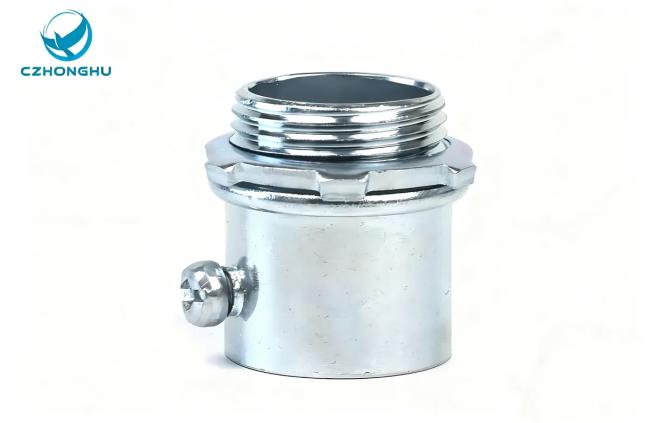
Both connector types perform the same basic function: connecting electrical metallic tubing (EMT) to an electrical box, enclosure, or other equipment. Eaton, for example, manufactures EMT fittings in both set screw and compression configurations.
The primary difference is how the connector grips the EMT conduit.
An EMT connector set screw type uses one or more screws that tighten directly against the conduit wall. Once the EMT is fully inserted into the fitting, the installer tightens the screw to secure the tubing.
A compression connector uses a compression nut and ring or ferrule. Tightening the nut compresses the ring around the conduit, creating circumferential gripping force.
| Selection Factor | Set Screw Connector | Compression Connector |
| Connection method | Screw clamps against EMT | Ring compresses around EMT |
| Installation speed | Generally faster | Requires additional tightening |
| Typical application | Indoor commercial wiring | Commercial and industrial wiring |
| Mechanical grip | Reliable when correctly tightened | Strong, distributed grip |
| Wet-location suitability | Depends on specific listing | Only if specifically rated raintight |
| Installation tools | Screwdriver/nut driver | Wrench or suitable tightening tool |
Neither design should be selected by appearance alone. Material, listing, enclosure requirements, installation environment, and project specifications all need to be considered.
Set screw connectors are usually faster for repetitive installations.
The electrician inserts the EMT into the connector and tightens the set screw to the specified position or torque. This makes them particularly useful for projects containing hundreds of connections, such as:
Office buildings
Retail facilities
Warehouses
Schools
Commercial lighting systems
Interior branch-circuit installations
Installation speed can significantly affect labor costs on large projects, which is one reason the EMT connector set screw type remains common in commercial electrical construction.
Compression connectors require the nut to be properly tightened so that the compression ring grips the conduit. Installation can take slightly longer, particularly in confined spaces.
A correctly installed fitting of either type should provide a secure connection when used within its rated application.
Compression fittings have the advantage of applying gripping force around the conduit rather than concentrating the connection at individual screw contact points. Eaton notes that compression ring-and-nut designs provide a strong, secure termination for EMT conduit.
That does not mean a compression connector is automatically required for every demanding project. A properly specified and installed set screw fitting can provide dependable performance in ordinary commercial and industrial locations.
The installation environment should have more influence on connector selection than contractor preference alone.
For indoor electrical rooms, ceilings, walls, warehouses, and other dry locations, set screw connectors are often the most economical option.
They are especially attractive where contractors prioritize:
Fast installation
Simple visual inspection
Easy maintenance
Competitive fitting cost
High-volume installation efficiency
For these projects, a galvanized steel or zinc die-cast EMT connector set screw type can provide an effective balance between performance and installation cost.
Compression connectors are frequently considered when an industrial project requires a robust mechanical connection or when compression fittings are specified by the engineer.
Application conditions should still be checked carefully. Vibration, corrosion, dust, water, oils, temperature, and equipment movement may require fittings designed specifically for those conditions rather than simply changing from set screw to standard compression fittings.
This is one of the most important specification points.
A standard compression connector should not automatically be considered raintight.
Where EMT is installed outdoors or in wet conditions, select fittings identified for that environment. Eaton offers dedicated raintight EMT connectors and couplings designed to help prevent water from entering the conduit or enclosure.
Eaton also recommends using fittings classified as raintight for outdoor EMT applications.
Therefore, the correct comparison is often:
Standard set screw vs standard compression for dry locations and listed raintight fittings for wet or outdoor locations.
When purchasing EMT fittings, evaluate more than connector price.
Determine whether the project is:
Indoor and dry
Damp
Outdoor
Exposed to water
Corrosive
Subject to vibration
Installed around industrial equipment
Environmental classification can immediately eliminate unsuitable fitting types.
Engineering specifications may explicitly require set screw, compression, steel, zinc die-cast, insulated, or raintight fittings.
Listed products should be used according to their intended application and installation instructions.
Common EMT connector materials include steel and zinc die cast. Eaton, for example, offers both materials across its EMT fitting range.
For purchasing departments, material should be clearly stated in the RFQ rather than requesting only "EMT connectors."
A lower fitting price does not always produce the lowest installed cost.
For thousands of indoor connections, the simple installation method of set screw connectors can improve productivity. For installations where compression fittings are specified, the additional installation time needs to be included in project costing.
Confirm:
EMT trade size
Connector or coupling
Set screw or compression type
Steel or zinc die-cast construction
Insulated or non-insulated throat
Indoor or raintight requirement
Required certifications
Quantity and packaging
Providing these details helps manufacturers quote accurately and reduces the risk of receiving the wrong fittings.
Do not select a standard set screw connector merely because the conduit is EMT. Outdoor installations should use fittings specifically identified for the environmental condition. Raintight EMT fittings are available for installations requiring protection against water entry.
No. Compression does not automatically mean raintight. Standard compression connectors and listed raintight compression fittings should be treated as different products. Always verify the manufacturer's rating.
Not universally. Compression connectors offer a strong circumferential grip, while set screw connectors can provide faster and more economical installation in dry commercial applications. The better connector is the one correctly matched to the environment and project specification.
Yes. Set screw and compression types are both established EMT fitting configurations used to connect EMT to boxes and enclosures.
For high-volume indoor dry-location construction, set screw fittings are often the practical choice. For projects specifying compression connections, choose the appropriate compression fitting. For wet or outdoor installations, select a fitting specifically listed and designed as raintight rather than relying on the connection style alone.
When sourcing EMT fittings for commercial or industrial projects, provide the conduit size, fitting type, material, environmental requirement, certification, and required quantity. This makes it easier to select the correct EMT connector set screw type or compression connector and obtain an accurate project quotation.
 English
 português
 Deutsch
 Nederland
 Español
 Polska