Call Us
+86-13503272331
Call Us
+86-13503272331

Outdoor electrical installations require reliable mechanical protection for cables exposed to sunlight, moisture, temperature changes, and physical impact. In modern infrastructure projects, outdoor cable trunking plays a critical role in organizing and protecting wiring systems in industrial, commercial, and utility environments.
Outdoor cable trunking is a protective cable management system designed to enclose and safeguard electrical cables from environmental exposure, mechanical damage, and UV degradation in external installations.
Choosing between PVC and metal materials is not just a cost decision—it directly affects system lifespan, maintenance frequency, and safety performance.
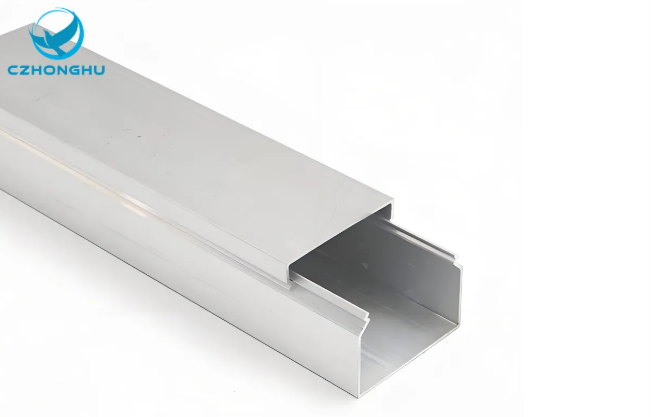
PVC and metal are the two most widely used materials for outdoor trunking systems. Each has different engineering behavior under environmental stress.
PVC is a non-metallic polymer known for corrosion resistance and ease of installation, while metal (typically galvanized steel or aluminum) is selected for structural strength and long-term durability in harsh environments.
According to industry installation references, PVC systems are generally preferred for lightweight and corrosion-prone environments, while metal systems are used where mechanical impact or fire resistance is critical.
The table below summarizes the most important technical differences:
| Property | PVC Outdoor Cable Trunking | Metal Outdoor Cable Trunking (Steel / Aluminum) |
| Corrosion resistance | Excellent, does not rust | Good if galvanized/coated, but may corrode if damaged |
| Mechanical strength | Moderate | High impact resistance |
| UV resistance | Requires UV-stabilized grade | Naturally UV resistant |
| Fire performance | Can soften under heat | Non-combustible, higher fire safety |
| Weight | Very lightweight | Heavier, requires stronger support |
| Installation speed | Faster, simple cutting and joining | Slower, requires tools and fittings |
| Lifespan (typical) | ~20–30 years depending on UV exposure | ~30+ years with proper coating |
| Cost level | Lower initial cost | Higher material + labor cost |
PVC trunking is widely chosen for cost-sensitive installations, while metal systems dominate heavy-duty industrial applications where physical protection is critical.
PVC trunking is widely used in outdoor electrical infrastructure because it is lightweight, easy to install, and resistant to chemical corrosion.
Corrosion-free performance even in coastal or humid environments
Easier installation without threading or welding
Lower material cost compared to steel systems (often 30–40% cheaper in similar sizes)
Suitable for underground or low-impact outdoor routing
However, PVC has technical constraints that must be considered:
UV exposure can degrade non-stabilized PVC over time, causing brittleness
Lower structural strength under mechanical impact
Thermal expansion requires proper installation spacing in long runs
Not ideal for high-load industrial environments
In outdoor projects, UV-stabilized PVC is essential; otherwise, long-term exposure may reduce service life significantly.
The metal wire trunking is typically manufactured from galvanized steel or aluminum and is designed for demanding environments where durability is more important than installation speed.
High mechanical strength suitable for industrial environments
Excellent fire resistance (non-combustible material)
Longer service life in high-impact zones
Can support heavy cable bundles without deformation
Steel systems are commonly used in factories, power plants, and infrastructure corridors where physical protection is essential. In many industrial designs, steel trunking can exceed 30 years of service life when properly coated.
Higher installation labor cost due to cutting, bending, and fixing requirements
Risk of corrosion if protective coating is damaged
Heavier weight increases structural support requirements
Higher total project cost compared to PVC
When selecting outdoor cable trunking, environmental conditions are often more important than material price.
Coastal areas with salt exposure
Underground cable routes
Chemical plants or fertilizer zones
Light commercial outdoor installations
Industrial facilities with mechanical impact risk
High-temperature environments
Public infrastructure (bridges, tunnels, stations)
Areas requiring fire-rated containment
A key engineering principle is simple:
PVC resists corrosion, while metal resists impact and fire.
PVC systems typically use solvent cement or snap-fit connections, making installation faster and requiring fewer specialized tools. Metal systems require additional steps such as:
Cutting and deburring
Bending or threading
Grounding continuity considerations
Industry installation guides consistently show that PVC reduces labor time significantly compared to metal systems in similar routing lengths. Maintenance also differs:
PVC: minimal corrosion inspection needed
Metal: periodic inspection of coating and joints required
PVC is often chosen for budget-sensitive projects due to its low upfront cost. However, metal can provide better lifecycle value in harsh environments. A simplified engineering view:
PVC → lower CAPEX (initial cost)
Metal → lower long-term replacement risk in heavy-duty environments
This is why infrastructure projects often combine both materials rather than relying on a single system.
To simplify decision-making:
Choose PVC outdoor cable trunking if:
Environment is low-impact
Corrosion resistance is priority
Budget is limited
Installation speed is important
Choose metal outdoor cable trunking if:
Mechanical protection is critical
Fire safety compliance is required
System is part of industrial infrastructure
Long service life under harsh conditions is needed
Many modern engineering systems use a hybrid approach—PVC for buried or low-risk sections and metal for exposed industrial zones.
In large-scale projects such as solar farms, telecom stations, and industrial plants, heavy duty cable trunking systems are often integrated with modular cable management structures like tray and ladder systems.
Manufacturers such as EMT Cable Tray design solutions that support both PVC and metal trunking configurations depending on installation conditions, ensuring compatibility across different engineering environments.
PVC and metal outdoor cable trunking serve different engineering purposes rather than competing directly. PVC is optimized for corrosion resistance, low cost, and easy installation, while metal provides superior mechanical strength and fire resistance. The correct choice depends on environmental conditions, load requirements, and project lifecycle expectations. In modern infrastructure design, selecting the right material improves safety, reduces maintenance, and ensures long-term system reliability.
 English
 português
 Deutsch
 Nederland
 Español
 Polska